Electric Current Measurement
The electric currents collected on the outer electrodes are extremely small, ranging from 1 to 3 fA per electrode in the cluster ion range, and even smaller for intermediate ions1.
The NAIS employs integrating electrometric amplifiers that collect electric charge fluxes on high-quality electrical capacitors. The amplifiers' output voltages are proportional to the collected charge, with voltage changes directly proportional to the incoming aerosol current.
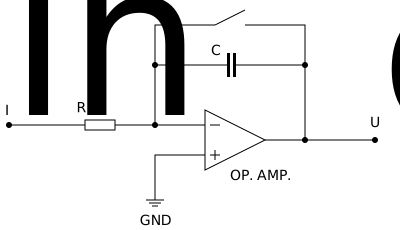
Integrating amplifier circuit
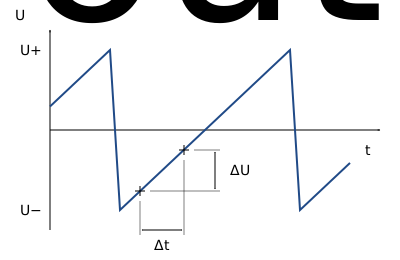
Integrating amplifier principle
The integrating measurement principle allows for the best possible signal to noise ratio for electric current measurements. Also, the signal is collected continuously almost without any breaks – no signal is missed regardless of measurement frequency.
Amplifier output voltages are sampled 10 to 15 times per second. This raw signal undergoes several processing steps to calculate the average signal for a given period and deduce the particle distribution. For high concentrations, 1-second average spectra provide a sufficiently low signal-to-noise ratio for practical use.
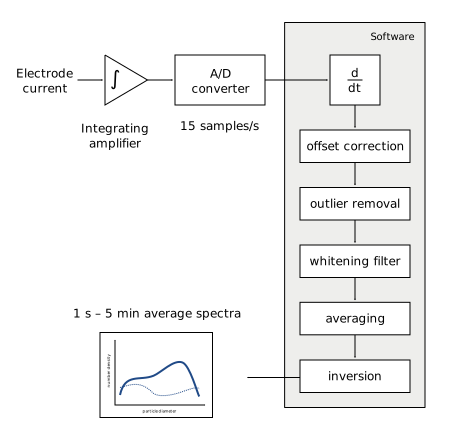
Signal-processing flow diagram of the NAIS
Offset correction
Electric current values are first corrected for offset currents, which are periodically measured during the offset operating mode. Estimated noise levels are included with the records, ensuring that all subsequent processing steps account for both signal and noise. These offset corrections and noise estimates are crucial for accurate data processing.
The offset signal is estimated via linear regression, utilizing current measurements from both previous and subsequent offset measurement cycles. Consequently, the final measurement result becomes available only after the completion of the next offset measurement cycle. The residual between the regression estimate and the actual offset signals provides an estimate of the raw signal variance. Each averaged record includes a current variance estimate, which expresses the variance of the mean derived from this raw signal variance. The estimate is inversely proportional to the time period covered by the record. When computing custom averages from multiple records, inverse variance weighting should be used.
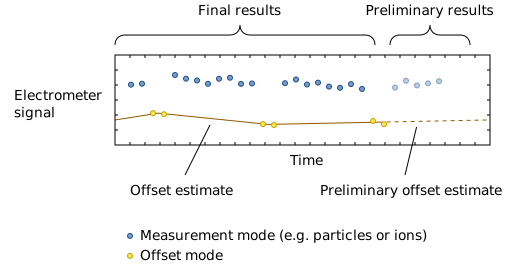
Offset estimates are subtracted from the raw measurement signal. The measurement results are considered preliminary until the subsequent offset measurement has been completed. After that, a final offset current estimate is calculated, the records are updated and stored.
Outlier removal
Short spikes frequently appear in the electric current signal, which are not attributable to actual aerosol measurements. These are most likely caused by the random decay of radioactive particles deposited on the electrodes. The frequency of these spikes increases with the accumulation of dirt on the electrodes.
A simple outlier detection algorithm discards these false signal measurements. Reliable spike detection is maintained as long as the instrument remains relatively clean. The "Dropped outlier samples" measurement parameter, found in the block average records, indicates the number of discarded samples, with each drop pertaining to a single electrometer.
Filtering
The high measurement rate enables optimal signal processing using an ARMA filter. The electric current signal is passed through a matched digital filter to whiten the noise distribution, thereby improving the effectiveness of averaging over short periods (e.g., 1 to 10 seconds)2.
Electrometer resets
Periodically, the collected charge on the capacitors must be cleared. In NAIS, electrometers automatically reset when the output signal reaches +2 V or −2 V. During the roughly ten-second reset and settling period, the signal from that electrometer is ignored.
At low concentrations, resets occur less frequently than once per hour. Resets are also performed preemptively during operating mode switches, when measurement data is discarded anyway, so they have no visible effect on the output data.