Principles of Operation
Overview
The NAIS is a multichannel aerosol instrument designed to measure size and mobility distributions of aerosol particles and air ions in the atmosphere. It can measure ion distributions (charged particles and cluster ions) of both polarities within an electric mobility range of 3.2 to 0.0013 cm2/V/s, and aerosol particle distributions in the size range of 2.0 to 40 nm. The NAIS is a successor to the Air Ion Spectrometer (AIS)1.
Specifically designed for monitoring atmospheric nanometer aerosol, the NAIS can operate for extended periods across diverse ambient conditions—from polluted urban areas to remote forests. It measures the size distributions of naturally charged particles (ions) of both polarities, as well as uncharged particles.
Specifications
| Feature | Description |
|---|---|
| Measurement range | Particle distribution: ~2 to 40 nm |
| Ion distribution: 3.2 to 0.0013 cm2/V/s | |
| (equivalent size range: 0.8 to 40 nm) | |
| Sample flow rate | 54 l/min |
| Time resolution | 1 second (1-5 minute averages typically used for long-term monitoring) |
| Power consumption | Typically < 100 W, AC 110/240 V |
| Dimensions | L 580 mm, W 305 mm, H 810 mm |
| Weight | 60 kg |
| Consumables | None |
| Servicing frequency | 1 to 6 months |
Description
The NAIS employs the principle of electrical aerosol spectrometry, featuring two identical, parallel-operating multichannel electrical mobility analyzer columns. These columns differ only in the polarity of ions measured. Aerosols are synchronously mobility-classified within the analyzers and measured by an array of 25 electrometers per column.
The two parallel measurement columns, with opposing polarities, enable the NAIS to detect variations in the atmosphere's natural electric charge balance and assess the potential effects of electric charge polarity on nanometer-sized aerosol charging.
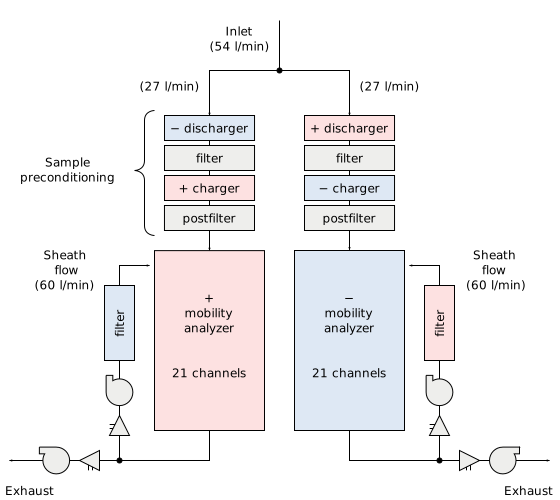
The NAIS primary component and airflow scheme.
Both columns are equipped with a software-controlled sample preconditioning unit, located in front of the analyzers, which includes unipolar corona chargers and electric filters. The preconditioner's operating mode dictates the instrument's measurement focus, allowing it to detect either only ions or all particles, including the uncharged fraction, by changing its operating mode:
-
Ions mode In this mode, all preconditioning unit components are switched off, leaving the aerosol sample unmodified. Consequently, only naturally charged particles are sensed by the electric mobility analyzer, and the NAIS operates identically to the AIS.
-
Particles mode In this mode, the instrument detects all particles, including the uncharged fraction, by utilizing the main corona charger. The post-filter removes excess charger ions. This corresponds to the electrical measurement principle2, where aerosol charging is followed by mobility analysis and data acquisition. Thus, in this operating mode, the NAIS functions similarly to the Electrical Aerosol Spectrometer (EAS)3.
-
Alternating charging mode Similar to particles mode, this mode additionally activates the discharger to enhance instrument performance when measuring aerosols with non-steady-state charge distributions. This neutralizes the aerosol sample, thereby minimizing the influence of the particle's initial charge on the measurement results.
-
Offset mode In this mode, only the discharger and its adjacent filter are active, preventing detectable particles from entering the analyzer. This mode serves to periodically verify instrument operation, including evaluating noise levels and measuring parasitic currents.
The NAIS measurement process is fully automatic and closely monitored. Airflows are maintained by four blowers, automatically adjusted to ensure a constant sampling volume flow rate and to counteract the effects of air pressure variations on particle mobility. Particle charging and filtering are also continuously monitored and software-adjusted.
All instrument components are housed within a single enclosure. The NAIS requires an external computer, connected via an Ethernet connection, to operate measurements. Both Windows and Linux operating systems are supported.
The NAIS neither uses nor produces harmful materials. Sampled aerosols undergo only electrical treatment; electric charging and filtering are natural processes to which particles are continuously exposed in the atmosphere.
Periodic cleaning is necessary for the NAIS to remove deposited particles from the mobility analyzer and corona needle tips. The cleaning frequency varies with pollution levels; for instance, during forest measurements, the NAIS can operate without maintenance or human interaction for over three months.
For details on the instrument operation see Mirme (2011)4 and Mirme & Mirme (2013)5.
-
Mirme, A., Tamm, E., Mordas, G., Vana, M., Uin, J., Mirme, S., Bernotas, T., Laakso, L., Hirsikko, A., & Kulmala, M. (2007). A wide range multi-channel Air Ion Spectrometer. Boreal Env. Res., 12, 247–264. ↩
-
Flagan, R. C. (1998). History of Electrical Aerosol Measurements. Aerosol Science and Technology, 28, 301–380. ↩
-
Tammet, H., Mirme, A., & Tamm, E. (2002). Electrical aerosol spectrometer of Tartu University. Atmospheric Research, 62(3-4), 315–324. ↩
-
Mirme, S. (2011). Development of nanometer aerosol measurement technology. PhD Thesis, University of Tartu. ↩
-
Mirme, S. & Mirme, A. (2013). The mathematical principles and design of the NAIS — a spectrometer for the measurement of cluster ion and nanometer aerosol size distributions. Atmospheric Measurement Techniques, 6(4), 1061–1071. doi:10.5194/amt-6-1061-2013 ↩