Sample Preconditioning
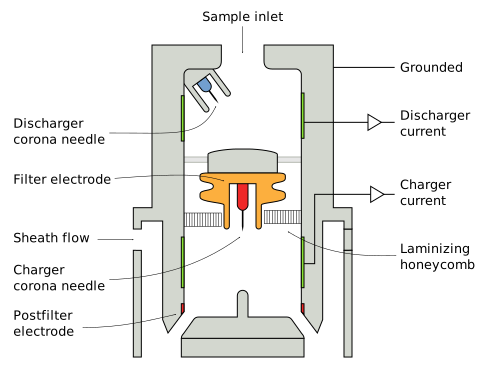
Schematic of the sample preconditioning unit
Chargers
Both analyzer columns of the NAIS are preceded by a charger and a discharger. All the chargers and dischargers are unipolar corona chargers.
Ions from the tip of the needle travel across the aerosol sample flow and attach to particles mainly by thermal diffusion.
To minimize particle loss and maximize charging efficiency, the electric field strength in the charger volume is kept as low as possible, while maintaining a high charger ion concentration. This means the charger operates close to the corona ignition limit.
Corona discharge is inherently unstable. The NAIS employs a feedback system to stabilize the corona by adjusting the needle voltage based on the electric current of charger ions to the outer electrode. This is reflected as the "Charger current" or "Discharger current" parameter in the measurement software.
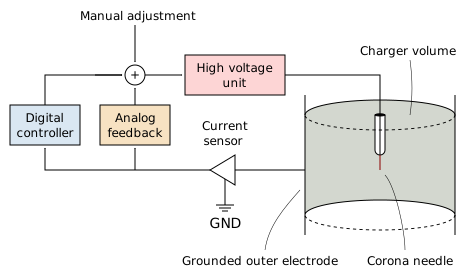
Charger control principle
The NAIS utilizes a software PID controller to adjust the charger voltage. The charger current may be different for the different operating modes of the instrument.
If the corona needle becomes too dirty, the automatic control will be unable to keep the corona stable. The charger current will start to fluctuate rapidly. The fluctuation is very fast and may not be visible in 1 second average data. See Charger fluctuation troubleshooting for checking the issue and Charger cleaning for cleaning instructions.
The charger currents in particles mode are typically about 20 nA. The discharger currents in offset mode are about 20 nA and in alternating charging mode about 10 nA.
Filter
The main filter, an electric filter, is situated between the discharger and the charger. It is activated in the offset measurement mode to prevent particle deposition on the analyzer's collecting electrodes. The discharger charges particles to the opposite polarity of detection, and the filter then removes the majority of these charged particles, preventing them from inducing currents in the analyzer.
The main filter electrode resembles a pulley wheel. The filter voltage when switched on is about 500V.
Post-filter
Ions created by the corona discharge are in the same size range as the smallest particles measured by the instrument. If they are allowed to pass into the analyzer then they would saturate the first measurement channels as well as cause invalid signal in later channels. The post-filter is used to remove the particles before the analyzer.
The post-filter voltage balances charger ion penetration and small particle removal. Since corona ion mobility varies with air temperature, humidity, and gaseous impurities, the NAIS instruments use a software algorithm to automatically adjust the post-filter voltage. This algorithm maintains a constant low average current in the analyzer's first channels, proving effective for long-term atmospheric monitoring. For laboratory experiments with dynamic aerosol distributions, automatic adjustment can be disabled.
Post-filter adjustments occur at the end of particle measurement cycles, making the process relatively slow. Initial startup may require 30 minutes to several hours for the algorithm to stabilize. Filter states are saved, allowing subsequent measurement runs to begin with previously established values.
The post-filter is active in particles and alternating charging measurement modes – it is always switched on when the main charger is active and switched off otherwise. The post-filter voltage is typically around 50V.
The post-filter is a small ring in the lower part of the main charger space at about the same level as the top of the mobility analyzer central column.