Mobility Analyzers
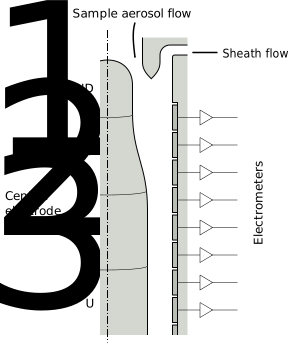
The principle of the mobility analyzer
The mobility analysis in NAIS corresponds exactly to the parallel electrical aerosol measurement principle. The capacitances between the collecting sections and sections of central electrodes for the NAIS are presented in Table 1. The table also shows the voltages of the respective sections.
Note that the collecting sections 9, 13 and 17 have some capacitance with two adjacent central sections. These sections may show higher noise levels compared to neighboring sections when the central electrode voltages have not stabilized yet after power-on or when the instrument is vibrating.
Table 1: Electrical Capacitances (C#V, unit pF) between collecting sections and the four central sections of the NAIS mobility analyzer.
| Elm. # | C9V | C35V | C150V | C700V |
|---|---|---|---|---|
| 1 | 2.5 | |||
| 2 | 2.5 | |||
| 3 | 2.5 | |||
| 4 | 3.1 | |||
| 5 | 4.1 | |||
| 6 | 5.9 | |||
| 7 | 8.4 | |||
| 8 | 9.0 | |||
| 9 | 3.6 | 5.2 | ||
| 10 | 8.8 | |||
| 11 | 8.7 | |||
| 12 | 10.0 | |||
| 13 | 4.9 | 5.9 | ||
| 14 | 11.1 | |||
| 15 | 11.5 | |||
| 16 | 14.0 | |||
| 17 | 11.0 | 2.6 | ||
| 18 | 13.6 | |||
| 19 | 13.6 | |||
| 20 | 13.6 | |||
| 21 | 13.6 | |||
| 22 | 13.6 | |||
| 23 | 13.6 | |||
| 24 | 13.6 | |||
| 25 | 13.6 |
Table 2: Diameter (ds to dl, unit nm) and mobility (zs to zl, unit cm2/V/s) ranges for each electrometer section.
| Elm. # | ds | dl | zs | zl |
|---|---|---|---|---|
| 1 | 0.66 | 1.07 | 4.68 | 1.77 |
| 2 | 0.89 | 1.29 | 2.54 | 1.22 |
| 3 | 1.07 | 1.48 | 1.75 | 9.28 10-1 |
| 4 | 1.23 | 1.68 | 1.34 | 7.19 10-1 |
| 5 | 1.39 | 1.92 | 1.04 | 5.51 10-1 |
| 6 | 1.59 | 2.20 | 7.98 10-1 | 4.18 10-1 |
| 7 | 1.84 | 2.58 | 5.98 10-1 | 3.06 10-1 |
| 8 | 2.14 | 2.91 | 4.43 10-1 | 2.40 10-1 |
| 9 | 2.42 | 3.65 | 3.47 10-1 | 1.53 10-1 |
| 10 | 3.05 | 4.53 | 2.19 10-1 | 9.96 10-2 |
| 11 | 3.78 | 5.26 | 1.43 10-1 | 7.37 10-2 |
| 12 | 4.37 | 5.98 | 1.07 10-1 | 5.72 10-2 |
| 13 | 4.97 | 7.78 | 8.28 10-2 | 3.40 10-2 |
| 14 | 6.45 | 9.99 | 4.92 10-2 | 2.07 10-2 |
| 15 | 8.29 | 11.83 | 2.99 10-2 | 1.48 10-2 |
| 16 | 9.81 | 13.79 | 2.14 10-2 | 1.09 10-2 |
| 17 | 11.42 | 16.54 | 1.58 10-2 | 7.65 10-3 |
| 18 | 13.71 | 22.36 | 1.11 10-2 | 4.24 10-3 |
| 19 | 18.50 | 27.24 | 6.14 10-3 | 2.89 10-3 |
| 20 | 22.50 | 31.26 | 4.19 10-3 | 2.22 10-3 |
| 21 | 25.97 | 35.03 | 3.18 10-3 | 1.78 10-3 |
| 22 | 28.92 | 38.37 | 2.58 10-3 | 1.50 10-3 |
| 23 | 31.83 | 41.55 | 2.14 10-3 | 1.29 10-3 |
| 24 | 34.40 | 44.71 | 1.84 10-3 | 1.12 10-3 |
| 25 | 36.77 | 47.22 | 1.62 10-3 | 1.01 10-3 |
Under NTP conditions the NAIS uses a sheath flow rate of 60 l/min and a sample flow of 27 l/min per analyzer (30 l/min per analyzer on some older instruments).
The NAIS automatically adjusts its sample and sheath airflow speeds so that the particle sizing and volume sample flow remain constant regardless of air pressure. This allows the instrument to be used in varying conditions e.g. for airborne measurements1.
-
Mirme, S., Mirme, A., Minikin, A., Petzold, A., Hõrrak, U., Kerminen, V.-M., & Kulmala, M. (2010). Atmospheric sub-3 nm particles at high altitudes. Atmospheric Chemistry and Physics, 10(2), 437–451. doi:10.5194/acp-10-437-2010 ↩