Measurement Process
The NAIS measurement process is fully automatic; users only need to specify the measurement cycle.
The measurement software controls the instrument according to the measurement cycle, receives data from the instrument, processes it and produces measurement records and particle distributions. The data is continuously stored to data files. The software continuously performs diagnostic checks and notifies the user if something might require attention.
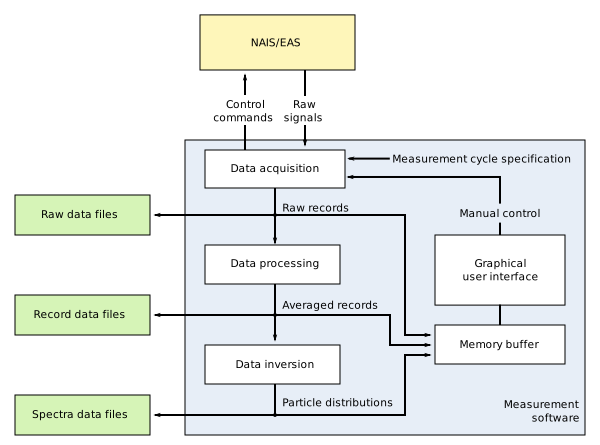
General overview of the measurement process of the NAIS software
Connection
The measurement software continuously attempts to establish a connection with the instrument and initiate measurements, unless manually stopped. Should the connection be lost, the software will persistently try to reconnect until successful.
It is safe to switch off or disconnect the instrument while the measurement software is running; the program will automatically reestablish the connection and resume measurements once the instrument becomes available.
Measurement cycle
The measurement cycle defines the sequence and duration of the instrument's operating modes.
Typically, the total cycle period ranges from 2 to 5 minutes, encompassing the combined duration of all specified operating modes. Each cycle should include one offset measurement of 30–60 seconds, along with one or more particle, ion, or other measurements.
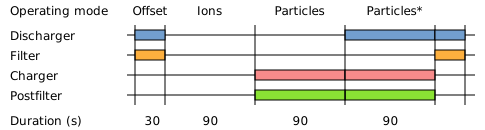
Typical measurement cycle of the NAIS. Offset measurements should be done for 20–30 seconds about every 5 minutes. Otherwise the user is free to choose the operating modes and their durations.
For example for long term monitoring the cycle "particles 120, ions 120, offset 60" would be recommended.
The instrument continuously measures all electrometer signals and diagnostic channels at a rate of 15–20 times per second, generating raw measurement records. These raw records are then processed by the measurement program to create averaged records.
The program consistently generates block average records, which represent one average record from the beginning to the end of each measurement cycle element. Users can also specify additional fixed-length averaging periods; by default, 1-second and 10-second averages are produced alongside the block averages.
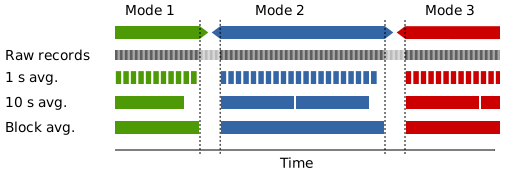
Raw records are measured continuously. Averaged records start when the instrument has settled after an operating mode switch.
When the instrument switches operating modes, a settling time of up to 10 seconds is required before accurate results are produced. This period allows chargers and filters to stabilize in their new state and properly conditioned particles to reach the measurement electrodes. The settling time is accounted for within the measurement cycle durations; thus, a 20-second operating mode duration yields slightly over 10 seconds of actual measurement results.
Therefore, it is recommended that the instrument remains in each operating mode for a minimum of 30 seconds to avoid significant loss of measurement time due to settling.
Fixed-length averaged records at the boundaries of operating modes may cover a shorter time period than the nominal averaging length. The actual time range is indicated by the begin and end timestamps.
Processed electrometer signals from averaged records are inverted to generate particle or ion distributions. While results are produced continuously, they are initially considered preliminary. Final results are calculated only after the completion of the subsequent offset measurement and the update of offset signal estimates (See Offset Correction).
Preliminary results are not saved to output files; they are only visible within the measurement program. Finalized data is saved. Upon program termination, any preliminary records are immediately stored without awaiting another offset cycle.
Records
Measured data is represented as measurement records, each corresponding to a specific time period and containing aggregate values of all data collected during that interval.
The averaged measurement records of the NAIS are made up of following fields:
- Begin time
- End time
- Operating mode
- Processed average electrometer currents
- Electrometer current variance estimates
- Raw average electrometer currents
- Average electrometer voltages
- Diagnostic parameters
- Diagnostic flags
Diagnostic parameters
Diagnostic parameters indicate the instrument's status and health. All signals from instrument sensors and control signals are stored as diagnostic parameters. Common parameter types include:
- Sensor voltages
- The actual voltages output from sensors as measured by the data acquisition system.
- Physical values
- The physical value of the parameter what the sensor measures.
- Control signals
- The output signals used to control some component of the instrument (e.g., blower power)
- Feedback target voltage
- Calculated sensor voltage that is the target value for automatic control channels. For example the flow rate sensor voltage that would match 60 l/min. The respective control signal is adjusted so that the sensor voltage would match the target voltage.
- Timing parameters
- Timing data about the raw measurement rate.
Diagnostic flags
Many instrument parameters are automatically monitored, and the software issues warnings if specific conditions are not met.
The warnings are represented by diagnostic flags, which are short text messages indicating different severity levels:
| Severity | Meaning |
|---|---|
| Notice | A normal event occurred (e.g., electrometer reset). |
| Warning | The instrument requires attention and might not be measuring correctly. |
| Failure | The instrument is definitely not measuring correctly. |
Spectra
Particle and ion distributions are calculated from measured electrometer currents using a data inversion procedure.
The distributions are represented by the number density spectrum vector, nd.
The diameter \(d_i\) and mobility \(z_i\) points densely cover the measurement range, evenly spaced on a logarithmic scale of size or mobility.
Fraction concentrations are determined through integration:
(or log z for mobility in the case of an ion spectrum).
Using a piecewise linear approximation, the fraction concentration between consecutive diameter or mobility points is simply the surface area of the trapezoid beneath the number density function segment:
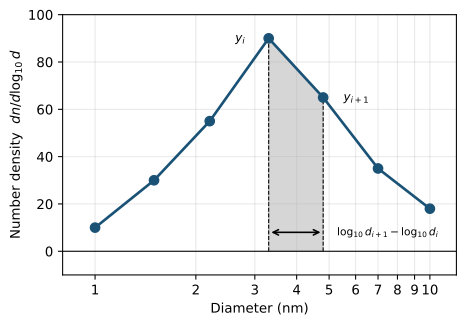
Number density